



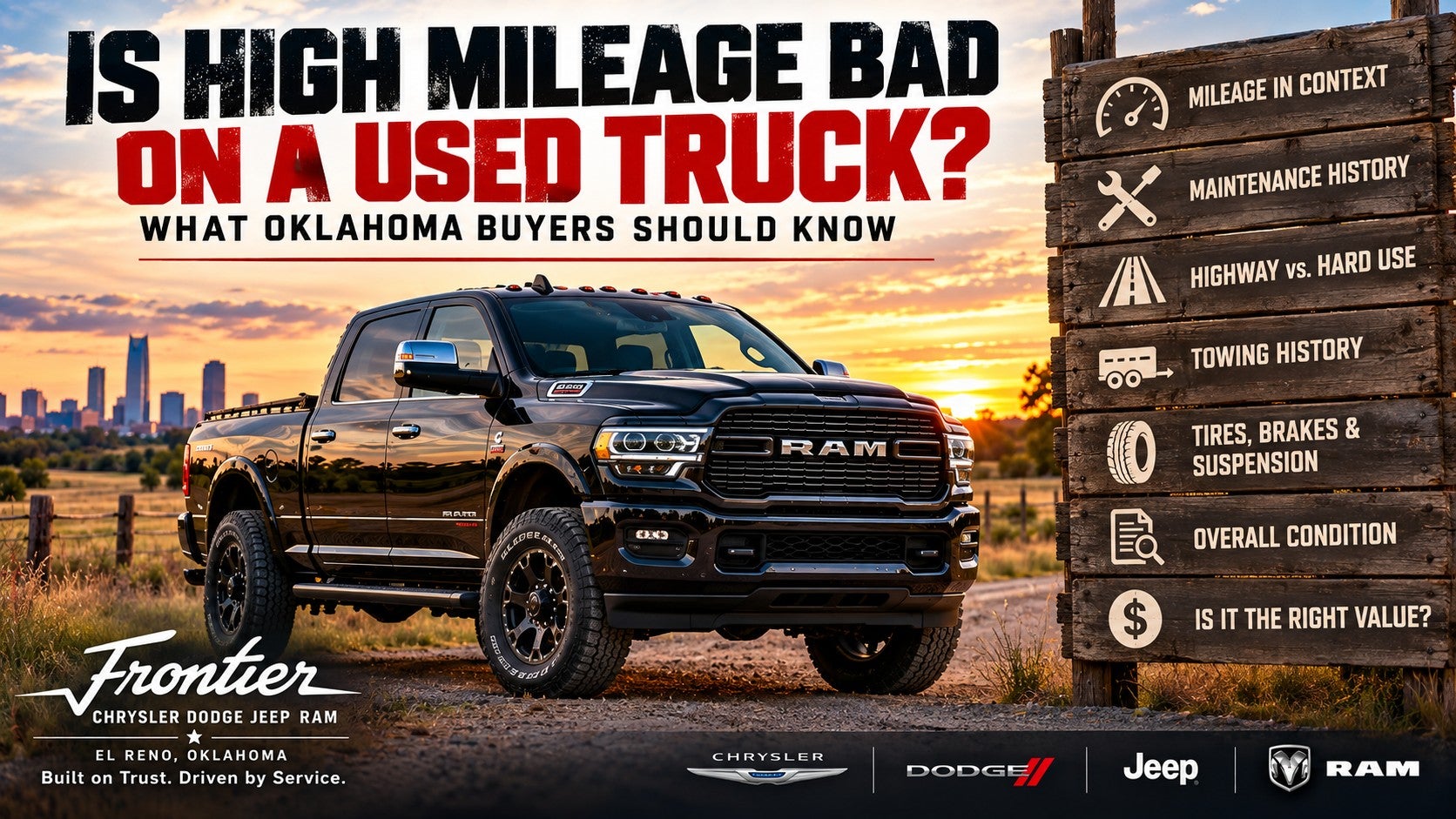
Is High Mileage Bad on a Used Truck? What Oklahoma Buyers Should Know
Seeing 80,000, 100,000 or even more miles on the odometer can make some used-truck shoppers immediately move on to the next vehicle.
But should it?
Not necessarily.
Mileage matters when you're buying a used pickup, but it is only one part of determining whether a truck represents a good value.
A truck with 100,000 well-maintained highway miles may be a better purchase for the right buyer than a lower-mileage truck that has experienced hard use, poor maintenance or years of demanding work.
At Frontier Chrysler Dodge Jeep Ram in El Reno, Oklahoma, we think the better question isn't simply:
"How many miles are on it?"
It's:
"What condition is the truck in, how was it maintained, and does the price make sense for what I'm buying?"
Here's what Oklahoma used-truck shoppers should consider before automatically ruling out a higher-mileage pickup.
What Is Considered High Mileage on a Used Truck?
There isn't one mileage number that suddenly makes a truck "high mileage" or a bad purchase.
Mileage needs context.
A five-year-old truck with 100,000 miles has averaged about 20,000 miles per year.
A ten-year-old truck with the same 100,000 miles has averaged about 10,000 miles per year.
Those trucks may have experienced completely different lives.
Age matters.
Mileage matters.
But neither tells the entire story.
That's why we recommend evaluating mileage alongside condition, maintenance, previous use, equipment and price.
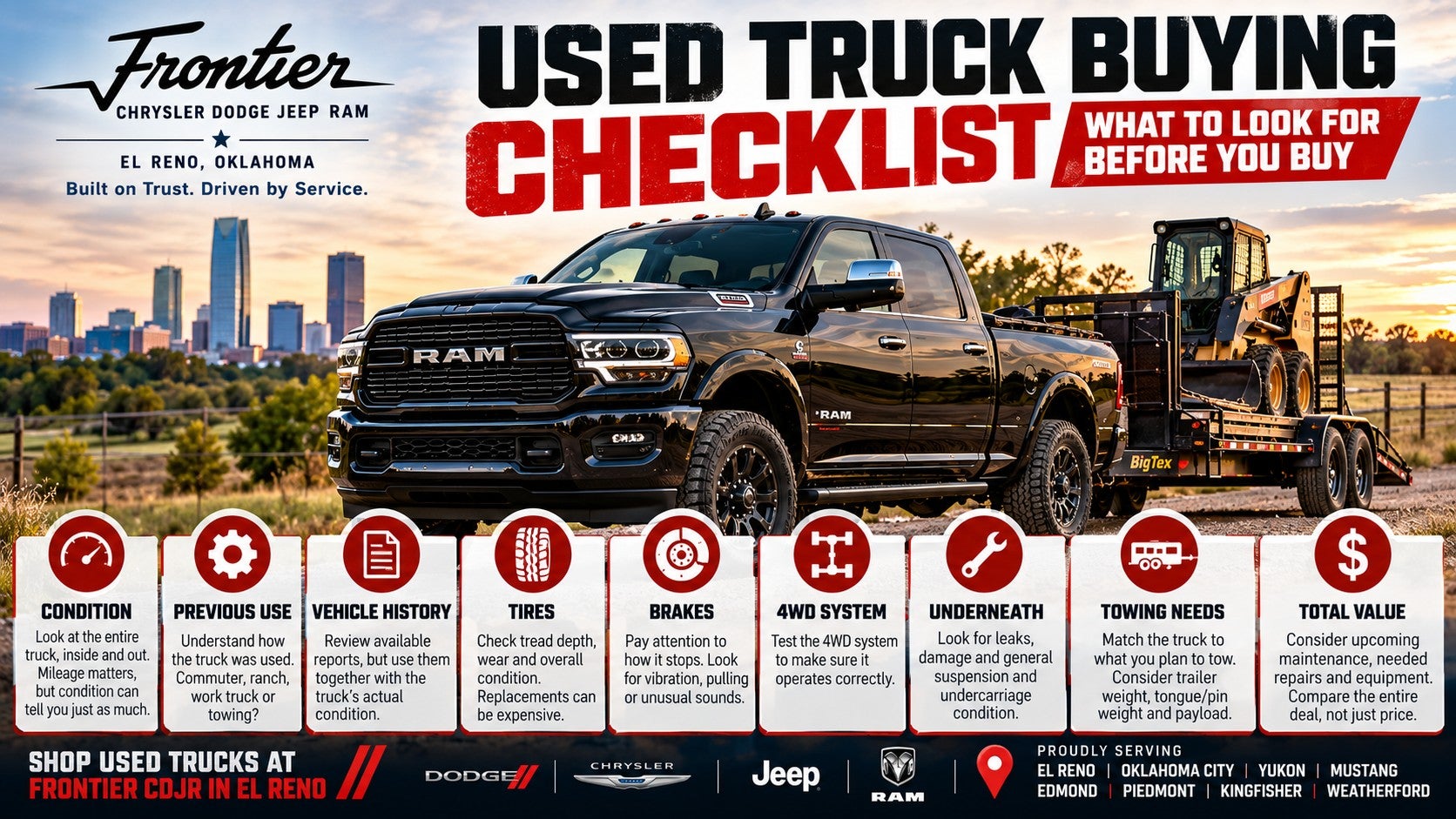
If you're beginning your search, our used truck buying guide for Oklahoma shoppers covers the other areas we recommend checking before you buy.
Highway Miles and Hard-Use Miles Aren't Necessarily the Same
Imagine two trucks.
One has 90,000 miles after spending several years traveling between Western Oklahoma and Oklahoma City on I-40.
The other has 60,000 miles but spent much of its life pulling equipment, traveling rough roads or working around jobsites.
Which truck has experienced more wear?
You can't answer that question from the odometer alone.
A truck accumulating mileage primarily through longer highway trips may have experienced a very different type of use than a pickup spending its life making short trips, idling, towing or operating in demanding environments.
That doesn't automatically make highway mileage good or work mileage bad.
It simply demonstrates why mileage needs context.
Maintenance Can Matter More Than the Number on the Odometer
A higher-mileage truck that has been maintained consistently deserves a different evaluation than one with an unknown or inconsistent maintenance history.
When information is available, consider the truck's maintenance history.
Regular oil changes and scheduled maintenance matter.
So does how the vehicle appears to have been cared for overall.
Look at the condition of the interior.
Look under the hood.
Look underneath the truck.
Pay attention to fluids, tires and brakes.
Take a meaningful test drive.
The condition of the entire vehicle can help tell a story that the odometer cannot.
Look at Mileage in Relation to Age
Mileage becomes more useful when you compare it with the age of the vehicle.A newer truck with unusually high mileage may have accumulated much of it through highway travel.
An older truck with exceptionally low mileage may sound appealing, but low mileage doesn't automatically mean the vehicle needs nothing.
Vehicles age even when they aren't driven extensively.
Rubber components, fluids, batteries, tires and other items can be affected by time as well as mileage.
That's why we wouldn't recommend buying a truck simply because the odometer shows an unusually low number.
Low mileage is a benefit—not a substitute for evaluating condition.
Previous Use Matters on an Oklahoma Truck
This is especially important around Oklahoma.
Trucks here work.
Some pull livestock trailers.
Some pull campers.
Some carry tools.
Some work farms and ranches.
Some travel oilfield or construction roads.
Some tow boats to the lake.
And plenty spend most of their lives commuting between communities like El Reno, Yukon, Mustang and Oklahoma City.
A pickup that was regularly used for demanding work should be evaluated differently from one that primarily served as transportation.
Neither truck is automatically the better purchase.
The important thing is understanding what you're buying.
Should You Be Concerned About a High-Mileage Ram 1500?
If you're shopping for a used Ram 1500, don't automatically eliminate a truck because it has crossed an arbitrary mileage threshold.
Evaluate the individual vehicle.
Consider its age.
Look at its condition.
Review available history and maintenance information.
Drive it.
Consider how it was equipped and how you plan to use it.
And then compare the asking price with what you're actually getting.
For someone needing a comfortable everyday pickup for commuting, projects and occasional recreational use, the right higher-mileage Ram 1500 may make sense.
Another buyer may prefer paying more for a lower-mileage truck because they intend to keep it for many years.
Both approaches can be reasonable.
What About a High-Mileage Ram 2500 or Ram 3500?
Heavy Duty trucks deserve an additional layer of evaluation because many were purchased specifically to work.
When you're considering a used Ram 2500 or Ram 3500 Heavy Duty, try to understand what the truck previously did.
Was it used for personal transportation?
Did it regularly pull a fifth wheel?
Was it used commercially?
Did it spend time around a farm or ranch?
Was it modified?
What does the bed look like?
What does the hitch area tell you?
How does the suspension look?
What condition are the tires and brakes in?
A Heavy Duty truck having towing miles isn't automatically a problem. That's part of what these trucks are designed to do.
But previous use is still something you should understand before buying.
If towing is important to your next truck, our Ram 1500 vs. Ram 2500 comparison and Oklahoma camper towing guide can help you determine which type of truck may better fit your needs.
Don't Forget About Idle Time
Mileage isn't the only way an engine accumulates operating time.
Trucks used commercially, on jobsites or in other applications may spend considerable time idling.
That can mean two trucks with identical odometer readings have experienced different amounts of actual engine operation.
When available and applicable, engine-hour information can provide additional context about how a truck was previously used.
Again, no single number tells you everything.
You're trying to develop a complete picture of the vehicle.
Look Closely at Tires, Brakes and Suspension
As mileage increases, normal wear items become increasingly important to your buying decision.
Pay attention to the tires.
How much tread remains?
Are they wearing evenly?
Will they need replacement soon?
How does the truck brake?
Do you notice vibration or unusual sounds?
How does the suspension feel?
Does the truck track properly down the road?
These things don't automatically make a higher-mileage truck a bad purchase.
But they can affect what the vehicle is worth to you.
A truck priced several thousand dollars below another option may not be the better value if you're immediately facing significant maintenance expenses.
Be Careful With Modified Higher-Mileage Trucks
Modifications deserve attention on any used truck.
They deserve even more attention as mileage increases.
Lift kits, leveling kits, oversized wheels and tires, suspension changes and performance modifications can all change how a vehicle operates and wears.
That doesn't mean you should automatically avoid a modified truck.
It means you should understand what has been changed.
If you're buying a modified truck for towing, also make sure the modifications fit what you intend to do with the vehicle.
The best-looking truck on the lot isn't necessarily the best truck for your particular job.
Does Higher Mileage Make a Used Truck a Bad Value?
Not if the price reflects what you're buying.
This is where the conversation gets interesting.
Imagine you're comparing two similar trucks.
Truck A has 55,000 miles and costs considerably more.
Truck B has 95,000 miles but is in good condition and priced thousands of dollars less.
Which one is the better value?
There isn't enough information to answer.
How long will you keep it?
How many miles will you drive each year?
How was each truck maintained?
What equipment does each have?
What condition are they in?
What maintenance may be coming?
How will you use the truck?
Value isn't simply about buying the truck with the fewest miles.
It's about what you're receiving for what you're paying.
A Higher-Mileage Truck May Make Sense If You Don't Drive Much
Here's another consideration shoppers sometimes overlook.
How much are you going to drive?
Someone who drives 25,000 miles per year may view mileage differently from someone who drives 5,000 miles annually.
If the truck will be a secondary vehicle, weekend truck or occasional tow vehicle, starting with higher mileage may be less important to that buyer than condition, capability and purchase price.
Your ownership plan matters.
That's why there isn't one correct mileage number for everyone.
When Should High Mileage Make You More Cautious?
Higher mileage should encourage you to evaluate the truck carefully.Pay particular attention when several concerns begin appearing together.
High mileage combined with poor condition deserves more scrutiny.
High mileage combined with limited maintenance information deserves more questions.
High mileage combined with extensive modifications deserves careful evaluation.
And high mileage combined with obvious signs of hard use should be reflected in your buying decision.
Mileage isn't necessarily the problem.
Mileage plus other warning signs is where the conversation changes.
Questions to Ask When Considering a Higher-Mileage Used Truck
Before making a decision, ask:How old is the truck?
How many miles does it have?
How does the mileage compare with the vehicle's age?
What maintenance information is available?
What does the vehicle-history information show?
How was the truck previously used?
Has it been modified?
What condition are the tires and brakes in?
How does it drive?
Does the four-wheel-drive system operate properly, if equipped?
What maintenance or repairs might be coming?
How long do I plan to own it?
How many miles will I drive annually?
What do I need the truck to do?
Those questions will tell you considerably more than asking whether 100,000 miles is "too many."
Why Buy a Used Truck From Frontier CDJR in El Reno?
We're not going to tell you mileage doesn't matter.It does.
We also don't believe the truck with the lowest mileage is automatically the best vehicle for every customer.
At Frontier Chrysler Dodge Jeep Ram, we'd rather help you look at the entire vehicle.
Condition.
Mileage.
History.
Equipment.
Capability.
Price.
And most importantly, whether the truck fits what you need it to do.
That's part of what we mean when we say:
Built on Trust. Driven by Service.
A pre-owned vehicle has a history.
Our job isn't to pretend otherwise.
Our goal is to help you understand the vehicle you're considering so you can decide whether it's the right one for you.
Shopping for Used Trucks Near Oklahoma City?
Frontier Chrysler Dodge Jeep Ram is located in El Reno, Oklahoma, west of the Oklahoma City metro along I-40.
We serve used-truck shoppers from El Reno, Yukon, Mustang, Oklahoma City, Edmond, Piedmont, Kingfisher,
Weatherford and communities throughout Central and Western Oklahoma.
Our current used truck inventory changes regularly and can include Ram trucks along with pre-owned pickups from other manufacturers.
If you see a truck that fits what you're looking for, come drive it.
Don't just look at the mileage.
Look at the truck.
Frequently Asked Questions About High-Mileage Used Trucks
Is 100,000 Miles Too Much for a Used Truck?
Not necessarily.Mileage should be considered along with the truck's age, condition, maintenance history, previous use, equipment and price.
There isn't one mileage number that automatically makes every used truck a bad purchase.
Is 150,000 Miles Too High for a Used Pickup?
A truck with 150,000 miles deserves careful evaluation, but mileage alone still doesn't determine whether the vehicle makes sense for a particular buyer.Condition, maintenance, previous use, expected future use and price become especially important as mileage increases.
Are Highway Miles Better Than City Miles?
Highway use and stop-and-go or severe-duty use can affect vehicles differently, but you shouldn't assume every highway-mile vehicle has been treated well.Use previous use as one part of your overall evaluation.
Is a Low-Mileage Used Truck Always Better?
No.Lower mileage can be attractive, but condition, age, maintenance, equipment, previous use and price also matter.
A lower odometer reading doesn't eliminate the need to inspect and drive the vehicle.
Should I Buy a High-Mileage Ram 1500?
A higher-mileage Ram 1500 may make sense depending on its condition, maintenance, previous use, price and how you intend to use it.Evaluate the individual truck rather than making the decision from mileage alone.
What Should I Check on a High-Mileage Ram 2500?
Consider the truck's maintenance and vehicle history, previous towing or commercial use, tires, brakes, suspension, modifications, drivetrain operation and overall condition.The same principle applies to a Ram 3500 or another Heavy Duty pickup.
Where Can I Find Used Ram Trucks Near Oklahoma City?
Frontier Chrysler Dodge Jeep Ram in El Reno serves Ram and used-truck shoppers from Oklahoma City, Yukon, Mustang, Edmond, Piedmont, Kingfisher, Weatherford and surrounding Oklahoma communities.Check our current used Ram and used truck inventory for current availability.
Don't Buy the Odometer. Buy the Truck.
Mileage deserves your attention.It just shouldn't make the decision by itself.
A higher-mileage pickup in good condition, with a history and price that make sense, may be exactly what one buyer needs.
Another buyer may be better served spending more for a lower-mileage vehicle.
That's why there isn't one answer.
Look at the truck.
Look at its history.
Consider how you'll use it.
Compare the entire value.
Then make the decision that makes sense for you.
If you're shopping for a pre-owned truck in Central or Western Oklahoma, visit Frontier Chrysler Dodge Jeep Ram in El Reno or browse our current used truck inventory.
We'll help you find the right truck—not simply the one with the lowest number on the odometer.
Frontier Chrysler Dodge Jeep Ram
El Reno, Oklahoma
Built on Trust. Driven by Service.